


Description
How to choose Trimmer Line
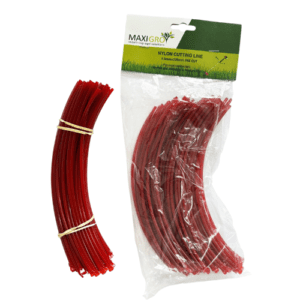
Maxigro Trimmer line comes in a round shape. The size of the line (3.5mm) refers to its diameter. The size of the trimmer line is one of the most important factors to consider and generally ranges from 1.2 to 4.5mm.
You may think choosing a larger size than required will get the job done quicker and easier or that there will be less risk of breaking the line. However, large trimmer line also requires more power form the machine. If you choose trimmer line that is too large for your brush cutter you risk slowing down the speed at which the engine can turn the cutting head which causes the system to ‘stiffen’. A 2-stroke engine can only lubricate itself properly if it is able to turn at full speed.
The opposite is also true. If you use a trimmer line that is too thin for the engine size, you will end up with mediocre performance compared to the amount of fuel you burn. The table below sets out basic guidelines to match trimmer line to the equivalent engine capacity of a 2-stroke engine:
|
Engine capacity |
Trimmer line sizes |
|
Under 20 cc |
1.2 to 1.4mm |
|
20 to 25 cc |
1.6 to 2.2mm |
|
25 to 35 cc |
2.3 to 2.7mm |
|
35 cc |
2.7 to 3mm |
|
40 cc |
3 to 3.5mm |
|
40 to 50 cc |
3.5 to 4mm |
|
Over 50 cc |
3.5 to 4.5mm |
Line thickness, vegetation and brush cutter power
- The thinnest trimmer line (1.2 to 2mm) is designed for short grass and low-growing plants grasses and clovers. This type of nylon line can only be fitted to less powerful trimmers.
- Thicker trimmer line (up to 3mm) is designed for longer grass and can be used for medium-powered brush cutters.
- The thickest trimmer line (3mm+) is designed for long grass and low undergrowth. This type of nylon line can be used with the most powerful brush cutters.